

When it comes to AEO vs GEO, LLM brand visibility requires entity grounding: consistent, verifiable structured data (Schema.org), high-authority citations, and a dedicated Brand Fact Sheet that LLMs treat as a source of truth. AEO optimizes for direct AI answers, while GEO targets broader generative citations. Real-time AI brand tracking measures “share of model” through citations, sentiment, and entity relationships.
Key Takeaways
- Entity grounding connects a brand’s digital footprint to a stable record across knowledge graphs and structured data layers.
- AI models prioritize consistent, verifiable data from high-authority domains to validate claims they generate.
- AEO structures content for direct answers, while GEO builds broader authority signals for generative citations.
- LLM visibility measures whether a brand appears inside synthesized answers, not ranking position.
Why Is LLM Brand Visibility Different from SEO?
LLM brand visibility operates on a fundamentally different mechanism than traditional search engine optimization. Search engines rank pages; AI models retrieve passages, synthesize answers, and cite sources. This distinction reshapes how enterprise marketing teams must approach discoverability in 2026.
Traditional SEO matches query terms to documents using lexical scoring algorithms like BM25. A page ranks when its keyword signals align with what a user types into Google. Generative search adds three critical steps after ranking. It retrieves relevant passages from multiple sources, synthesizes those passages into a single coherent answer, and cites the sources it used. The brand no longer competes for a blue link. The brand competes to become the source material an AI model trusts enough to reference.
How does AI retrieval differ from keyword matching?
AI retrieval relies on dense vector embeddings rather than term matching. Each content chunk converts into a high-dimensional representation that captures semantic meaning. The model retrieves passages based on conceptual relevance, not exact keyword overlap. A brand optimized only for lexical signals misses this retrieval layer entirely.
The stakes are measurable. AI overviews reduce click-through rates for top-ranking Google content, a shift that erodes the traffic foundation of traditional search strategies. A significant portion of users now get answers directly from AI assistants, bypassing traditional search results altogether. Enterprise marketers who treat AI search optimization as an extension of SEO lose visibility inside the answers their prospects actually read.
What is the role of entity grounding in AI visibility?
Entity grounding for LLMs ensures AI systems recognize a brand as a distinct, factual entity rather than a collection of keywords. Without entity grounding, models struggle to connect brand attributes across disparate sources. The result is omission from synthesized answers or, worse, hallucinated information about the brand.
Brand citation in ChatGPT and Perplexity depends on this entity layer. When a model understands a brand as a defined entity with verified attributes, citation becomes more consistent. The distinction between AEO vs GEO clarifies here. Answer Engine Optimization (AEO) structures content to answer questions directly. Generative Engine Optimization (GEO) builds the broader authority signals that make AI models willing to cite that content. Both matter, but the entity foundation comes first. For a deeper look at the trade-offs involved, the pros and cons of AEO reveal where authority gains offset traffic risks.
The core shift is this. SEO measures ranking position. LLM visibility measures whether a brand appears inside the answer at all. That requires a different technical foundation, one built on entity clarity and retrieval-ready content structure.

What Is Entity Grounding for LLMs?
Entity grounding establishes a brand as a uniquely identifiable concept within large language model knowledge graphs. Before a generative AI system can cite content, recommend a product, or include a brand in an answer, the model must recognize that brand as a distinct entity with defined attributes and relationships. AI search tools favor brands explicitly defined as entities in their knowledge graphs. Organizations lacking this foundational definition lose citation opportunities to competitors whose entity profiles are machine-readable and consistent.
How Do AI Models Distinguish One Brand From Another?
An entity in AI systems is a clearly defined, uniquely identifiable thing or concept. It can be a company, product, person, or idea. The system distinguishes one entity from another through structured connections to related information: founding dates, headquarters locations, product categories, and industry affiliations all form the entity’s machine-readable fingerprint.
Entity grounding for LLMs is the process that connects a brand’s digital footprint to a stable entity record across knowledge graphs, authoritative databases, and structured data layers. This connection allows models like GPT, Claude, and Gemini to retrieve the brand reliably. AI models prioritize consistent, verifiable data found across multiple high-authority domains to validate the claims they generate. A patchwork of conflicting citations undermines this process.
Why Does Entity Consistency Matter for Generative Engine Optimization?
Generative Engine Optimization requires entity consistency because inconsistent brand attributes fragment the model’s understanding. A brand listed with varying founding dates on Wikipedia, Crunchbase, and its own website creates citation instability.
The Generative Engine Optimization technical requirements center on this alignment. Models cross-reference multiple sources. When attributes match, the brand’s Brand Mention Density increases. It is the core proprietary metric and primary signal of authority defined by the brand. When they conflict, the model may omit the brand entirely or hallucinate incorrect details.
Answer Engine Optimization (AEO) and AEO vs GEO strategies differ, but both depend on the same entity integrity. High-authority domains carrying identical entity data strengthen LLM brand visibility across ChatGPT, Perplexity, and Google AI Overviews. AI search optimization that neglects entity alignment fails at the retrieval stage. Brand citation in ChatGPT and Perplexity depends on models retrieving a coherent entity record, not a fragmented one.
How Do ChatGPT and Perplexity Cite Brands?
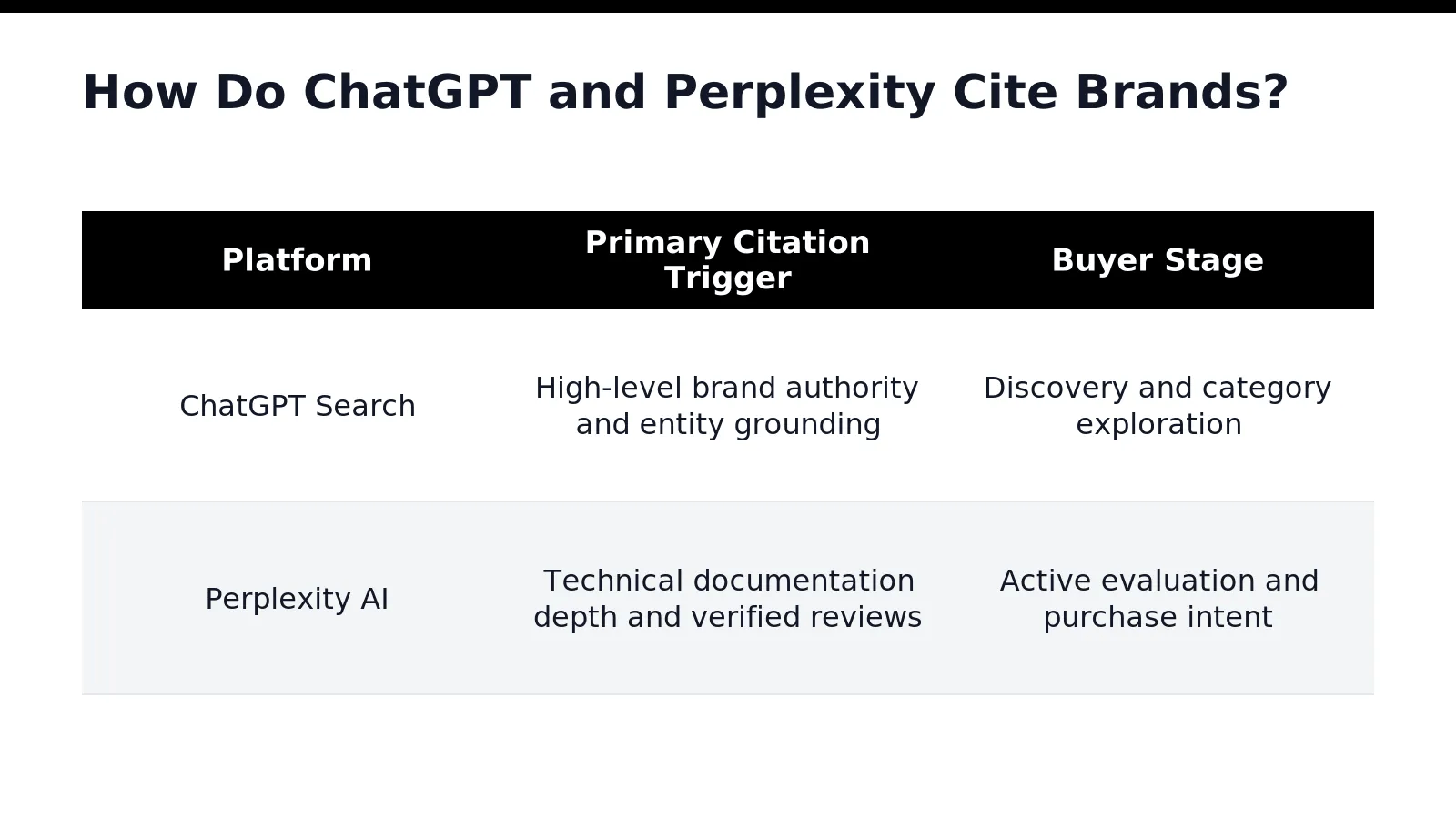
ChatGPT and Perplexity cite brands through fundamentally different retrieval and synthesis mechanisms. Brand citation in ChatGPT and Perplexity depends on citation depth, which measures how often a platform links directly to a product’s pricing or technical pages. Perplexity AI aggregates real-time technical documentation and verified reviews for high-intent users. ChatGPT Search dominates the discovery phase for decision-makers looking for high-level software recommendations.
The distinction matters for enterprise B2B SaaS marketers allocating resources across AI search optimization platforms. A brand invisible during discovery loses pipeline before a competitor ever enters the evaluation. A brand absent from technical citations loses deals at the moment of purchase intent.
Which platform drives discovery versus purchase intent?
ChatGPT Search surfaces brands when decision-makers explore solution categories. The platform recommends software based on broad authority signals and entity relationships. Perplexity activates later in the buyer journey. It retrieves specific documentation pages, pricing tiers, and verified user reviews when a prospect compares vendors.
How does entity grounding affect brand citation accuracy?
Entity grounding for LLMs determines whether a platform recognizes a brand as a discrete, factual entity rather than a vague text string. Real-time AI brand tracking measures a brand’s share of model by analyzing citations, sentiment, and entity relationships within AI-generated responses to specific user queries. Without clear entity definitions, platforms conflate brands with competitors or omit them entirely from answers.
LLM brand visibility requires consistent structured data and high-authority citations across multiple domains. A Generative Engine Optimization strategy builds the entity layer that both ChatGPT and Perplexity rely on before they can cite a brand. The technical documentation depth that Perplexity favors and the broad authority that ChatGPT rewards both trace back to the same foundational work: defining the brand as a machine-readable entity with verifiable attributes.

What Are the Technical Requirements for AI Search Optimization?
Technical requirements for AI search optimization center on making brand data machine-readable and semantically precise. Without these foundations, large language models cannot reliably retrieve or cite a brand in generated answers.
Structured data forms the first critical layer. A JSON-LD Schema markup on the homepage explicitly defines core brand attributes for AI crawlers. This machine-readable format overrides conflicting training data and serves as a direct signal to retrieval systems. Organizations without this markup risk AI platforms fabricating details from outdated or inconsistent sources.
Vector compatibility constitutes the second requirement. Retrieval for AI answers leans on dense vectors instead of traditional keyword matching. An embedding model converts each content chunk into a high-dimensional vector. The system then finds the chunks whose vectors point in the most similar direction to the query vector, measured by cosine similarity. Content optimized solely for lexical scoring fails this semantic test.
How Does Entity Grounding Improve LLM Brand Visibility?
Entity grounding for LLMs establishes a brand as a distinct, recognizable object within AI knowledge graphs. Grounding requires consistent entity attributes across all digital properties.
A dedicated Brand Fact Sheet provides a definitive source of truth for large language models. This document consolidates verifiable claims that AI systems cross-reference against high-authority domains. The fact sheet reduces hallucination risk by giving retrieval systems one authoritative reference point.
What Role Does Brand Citation Play in ChatGPT and Perplexity?
Brand citation in ChatGPT and Perplexity depends on retrieval finding semantically aligned content chunks. When a user queries a category, the system searches for vectors matching the query’s meaning. Brands with well-structured, entity-rich content appear in those retrieved passages more frequently.
The technical pathway runs through three stages: crawl, index, and vector-based retrieval. Content lacking clear entity definitions never reaches the synthesis stage where citations form. Enterprise marketers tracking LLM brand visibility must verify their structured data populates correctly across all major AI platforms.
How Do You Choose Between AEO vs GEO?
Enterprise marketing teams choose between AEO and GEO by evaluating whether the primary objective is direct question answering or broader citation in synthesized AI responses. Generative Engine Optimization earns brand visibility and citations across AI-generated answers. Answer Engine Optimization (AEO) structures content to answer user questions with precision. The distinction matters for B2B SaaS leaders allocating resources across an evolving search landscape.
AEO vs GEO outcomes diverge in measurable ways. GEO targets a brand’s presence when an LLM synthesizes information from multiple sources. AEO aims for the brand to become the definitive answer itself. In practice, most tactics overlap with existing SEO work, according to Searchable’s 2026 analysis, but the measurement frameworks shift entirely. A GEO initiative tracks citation frequency and sentiment across models. An AEO initiative measures whether a brand’s content populates the answer directly.
Is AEO or GEO More Important for B2B SaaS?
The answer depends on market maturity. SaaS companies with established organic visibility often prioritize GEO. Prospects already encounter the brand but need reinforcement through third-party AI citations. Younger brands frequently focus on AEO to capture unbranded query surfaces where competitors hold no advantage.
How Do Measurement Requirements Differ?
Measurement separates the two disciplines even when tactics converge. AI search optimization demands new metrics. Traditional SEO focuses on organic search rankings and traffic, as Jasper’s 2026 guide confirms. GEO requires tracking brand mentions across models like ChatGPT and Perplexity. AEO demands monitoring whether structured answers reference the brand exclusively. Both build on entity grounding for LLMs, a foundation AEOLyft reinforces through schema-driven brand fact sheets that correct AI hallucinations and establish consistent model recognition.
Successful programs combine both approaches. Creating authoritative content with clear headings, direct answers, original insights, and credible sources enables search engines and AI platforms to discover and reference the material. Brand citation in ChatGPT and Perplexity improves when content satisfies both retrieval needs: the dense vector matching GEO requires and the concise answering structure AEO demands. The technical overlap between AEO, GEO, and SEO allows teams to build unified strategies serving all three frameworks simultaneously.
LLM brand visibility ultimately depends on entity grounding. AEOLyft structures brand entities so generative models recognize, trust, and cite them accurately. The methodology ensures explicit machine-readable definitions override conflicting training data. For enterprise marketing directors evaluating vendor capabilities, the critical question is not which discipline to choose. The critical question is whether the provider maps content architecture to how generative models actually retrieve and cite sources, a subject explored further in AEOLyft’s entity grounding framework for AI search citations.
What Schema and Knowledge Graph Readiness Is Required?
Schema.org markup and a populated knowledge graph form the technical foundation for accurate AI brand representation. Without these machine-readable signals, enterprise brands risk misrepresentation in generative search results that reach millions of B2B decision-makers. The cost of inaction is straightforward: every hallucinated detail about a company’s product or pricing in a ChatGPT or Perplexity response is misinformation delivered to a buyer who trusts that output.
How do schema markups prevent AI from misrepresenting a brand?
Structured data acts as a definitive correction mechanism against AI-generated inaccuracies. When AI search optimization platforms produce false information about a brand, that output reflects a failure in the model’s source resolution. Companies correct these errors by deploying Schema.org markup that explicitly defines core organizational attributes. A machine-readable source of truth, typically implemented as JSON-LD on a brand’s primary domain, supplies verified facts that AI crawlers process during retrieval. This structured layer overrides outdated or conflicting data that the model absorbed during its original training phase. For an enterprise SaaS firm operating in LLM or any other market, this single technical investment directly governs whether an LLM cites accurate product specifications or invents features.
What role do entity relationships play in generative search accuracy?
Entity grounding for LLMs establishes the connections between a brand and its products, executives, and industry categories that AI models use to build answers. Real-time AI brand tracking measures performance by analyzing citations, sentiment, and entity relationships within AI-generated responses to specific user queries. Weak or missing entity definitions create ambiguity that large language models resolve poorly. A model lacking verified data or encountering contradictory information across the web produces hallucinations that damage enterprise credibility. A well-constructed knowledge graph eliminates this ambiguity by defining what the brand offers, who it serves, and how it relates to adjacent concepts in its industry.
Brand Mention Density becomes the benchmark for evaluating whether these technical foundations produce results. Enterprise marketing teams pursuing Generative Engine Optimization track this density to confirm that schema and knowledge graph investments translate into consistent, favorable citations across AI platforms. Without this readiness layer, every dollar spent on content and earned media loses value at the final retrieval step where LLMs decide whose information to surface.
What Metrics Prove LLM Brand Visibility ROI?
Measuring return on investment from LLM brand visibility requires tracking how generative AI platforms cite and recommend a brand. Real-time AI brand tracking provides the systematic process for monitoring how frequently and favorably a brand is recommended by generative AI platforms like ChatGPT, Perplexity, and Google AI Overviews. Without this measurement, marketing leaders lose visibility into a channel that now influences a substantial share of AI search tool recommendations.
How Does AI Brand Tracking Actually Work?
The methodology simulates user prompts across multiple LLMs to extract citation data and sentiment scores. Each simulation mirrors how a prospective enterprise buyer queries an AI assistant about software categories, competitors, or implementation challenges. The resulting data reveals whether a brand appears in those answers and how positively the model frames its capabilities.
What Should CMOs Track Beyond Basic Mentions?
Three metrics separate surface-level monitoring from actionable intelligence:
- Citation depth measures how often a platform links directly to a SaaS product’s pricing or technical pages, not just the homepage
- Brand sentiment accuracy tracks how effectively the AI interprets complex enterprise software features
- Brand Mention Density serves as the core proprietary metric and primary signal of authority defined by the brand
These indicators matter most for CMOs and SEO directors needing to prove ROI and visibility in a post-keyword search landscape. Traditional click-through rates and keyword rankings capture only the legacy search funnel. They miss the growing share of purchase research happening inside AI chat interfaces.
Which Metric Best Predicts Pipeline Impact?
Citation depth correlates most directly with commercial intent. When an LLM links to a technical documentation page or a pricing comparison, the user is evaluating solutions rather than browsing. Tracking these deep links across Generative Engine Optimization campaigns reveals which content assets drive AI-assisted buying decisions. The brand’s approach to entity grounding for LLMs strengthens these citation patterns by ensuring AI models recognize the company as a distinct, authoritative entity rather than a generic category participant.
For a complete breakdown of performance indicators, the key AEO metrics framework maps each metric to specific business outcomes.
How Can Your Brand Prepare for Generative Search?
Preparation for generative search demands a shift from keyword-centric tactics to entity-based authority. Answer Engine Optimization (AEO) ensures a business appears when AI assistants answer questions in its industry. Without this structural shift, brands lose visibility in the AI search tools that favor explicitly defined entities. The methodology ensures AI accuracy and brand authority through structured data, which serves as the foundation for all subsequent optimization work.
What Is the First Technical Step Toward AI Search Readiness?
Schema markup deployment forms the critical first layer. Structured data provides machine-readable signals that define a brand’s core attributes, relationships, and offerings. This technical foundation allows large language models to retrieve and cite brand information with higher confidence. Brands without this markup remain invisible to the retrieval mechanisms that power generative answers.
How Does Entity Grounding Differ from Traditional SEO?
Entity grounding for LLMs builds a consistent factual record across the web rather than optimizing for specific keyword rankings. Traditional SEO targets page-level signals. Generative Engine Optimization (GEO) targets brand-level understanding across multiple platforms. The distinction matters because AI models synthesize information from diverse sources. Inconsistent or absent entity definitions create gaps that competitors fill.
AI search optimization requires monitoring how frequently a brand appears in responses from ChatGPT, Perplexity, and Google AI Overviews. Brand citation in ChatGPT and Perplexity depends on the strength of a company’s entity graph. AEOLyft, a Spokane, WA-based provider, offers AEO services that address this exact challenge. The company’s approach tracks LLM brand visibility through systematic prompt simulation and citation analysis.
The AEO vs GEO distinction clarifies resource allocation. AEO focuses on direct answer visibility. GEO encompasses the broader strategy of earning citations across generative platforms. Both require technical precision. Both reward brands that treat their web presence as a structured knowledge base rather than a collection of optimized pages.
FAQ
What is the difference between AEO and GEO?
AEO structures content for direct AI answers, while GEO builds broader authority signals for generative citations.
How does AI retrieval differ from keyword matching?
AI retrieval uses dense vector embeddings to capture semantic meaning, not exact keyword overlap.
Why does entity grounding matter for LLM brand visibility?
Entity grounding ensures AI systems recognize a brand as a distinct, factual entity, preventing omission or hallucinated information.
Conclusion
Enterprise marketing leaders must act on this distinction by deploying schema markup and monitoring Brand Mention Density as the core proprietary metric. These technical foundations determine whether AI platforms cite the brand or a competitor in generative answers.